

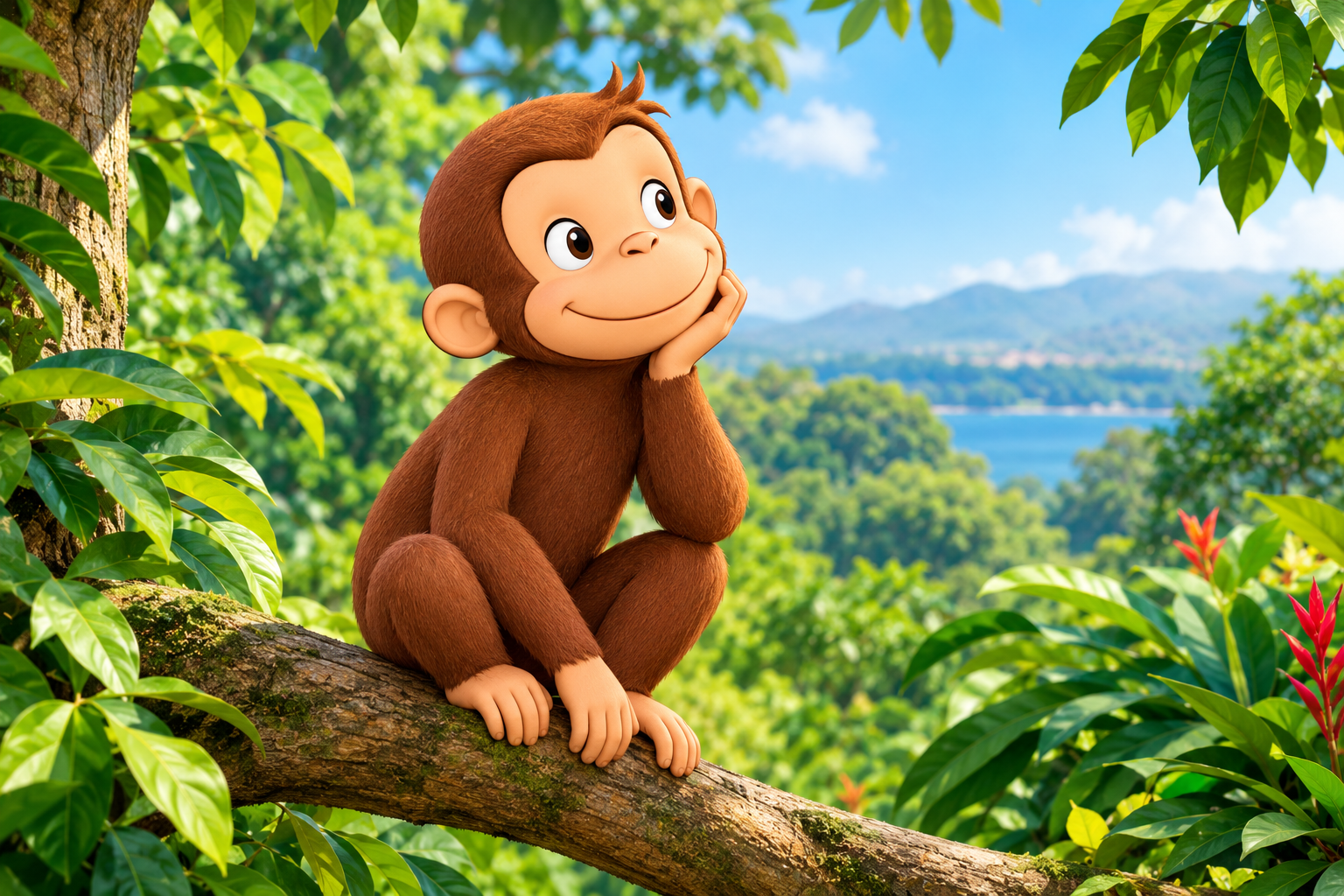
Curious George is one of the most recognizable animal characters in children’s literature. Known for his playful personality, endless curiosity, and amusing adventures, the little brown monkey has entertained generations of young readers and television viewers. But one question continues to interest fans: what type of monkey is Curious George?
Although the character is commonly called a monkey, his exact species is not clearly identified in the original children’s books. His appearance and behavior resemble a simplified, fictional primate rather than a scientifically accurate depiction of one particular species.
To understand why Curious George is difficult to classify, it helps to explore his origins, physical characteristics, and differences from real monkeys and apes.
What Type of Monkey Is Curious George?
Curious George is generally described as a small brown monkey, but his creators did not establish a specific real-world species for him.
The character was created by authors and illustrators H. A. Rey and Margret Rey. He first appeared in the original Curious George book, published in 1941.
George has a rounded face, large expressive eyes, brown fur, and a long tail that is notably absent from his usual illustrated appearance. These characteristics do not provide enough scientific information to identify him confidently as a particular species.
In everyday conversation, people often call George a monkey because that is how the character is presented in his stories. However, his design includes features that make him look somewhat like a young chimpanzee or other ape.
The most accurate answer is that Curious George is a fictional monkey whose precise species is unspecified.
Is Curious George a Chimpanzee?
One of the most common questions about the character is whether Curious George is a chimpanzee.
Chimpanzees are apes, not monkeys. They generally have no external tails, long arms, and bodies adapted for climbing and moving through trees or on the ground. Curious George also lacks a visible tail and has a body shape that can remind viewers of a young chimpanzee.
However, these similarities do not establish that George is a chimpanzee. His cartoon appearance is stylized, and the original books do not provide a definitive species identification.
There is an important distinction between visual resemblance and biological classification. A fictional character can share features with an animal without belonging to that animal’s exact species.
Therefore, although Curious George may look chimpanzee-like in some illustrations, it is not accurate to state definitively that he is a chimpanzee.
Is Curious George a Monkey or an Ape?
Understanding the difference between monkeys and apes helps explain the confusion.
Monkeys and apes are both primates, but they belong to different groups. Most monkeys have tails, although there are exceptions, while apes naturally lack tails.
<text size=”sm” color=”secondary”>General differences between monkeys and apes</text>
| Feature | Monkeys | Apes |
|---|---|---|
| Tail | Usually present | Absent |
| Examples | Capuchins, macaques, baboons | Chimpanzees, gorillas, orangutans, gibbons |
| Body structure | Varies by species | Often adapted for flexible shoulder movement and climbing |
| Intelligence | Highly varied; many species solve complex problems | Highly developed learning and social behavior |
| Curious George | Not a confirmed species | Not officially identified as an ape |
Because George has no visible tail, some people interpret him as an ape. Nevertheless, the character is consistently known as a monkey in popular descriptions.
His appearance is best understood as an artistic choice rather than a precise scientific model.
What Does Curious George Look Like?
Curious George’s recognizable design helps explain why different people identify him with different primates.
Brown Fur
George has warm brown fur that gives him a simple, appealing appearance. His coloring is common in illustrations of fictional monkeys but does not uniquely identify a real species.
Large Eyes
His large eyes communicate curiosity, surprise, excitement, and confusion. This expressive feature makes it easier for young audiences to understand his emotions without relying on dialogue.
No Visible Tail
Unlike many real monkeys, George is usually drawn without a visible tail. This is one of the main reasons some viewers associate him with apes, particularly chimpanzees.
Small Body and Rounded Face
His compact body, rounded head, and childlike proportions make him look approachable. These exaggerated features are common in children’s character design.
Taken together, these characteristics create a memorable fictional animal rather than a scientifically accurate portrait of a particular primate.
Why Is Curious George So Curious?
George’s curiosity is central to his personality. He enjoys exploring unfamiliar places, examining objects, meeting people, and discovering how things work.
His adventures often begin with a simple question or an interesting object. His desire to investigate leads to unexpected situations, which become opportunities for learning and problem-solving.
This curiosity is an important part of the books’ appeal because children naturally explore their surroundings in similar ways. George’s mistakes also show that experimentation can have consequences, while encouraging readers to think about solutions.
The character’s behavior is not intended as a scientific representation of any particular monkey species. Instead, his curiosity is a storytelling device that helps introduce young readers to everyday experiences.
Who Created Curious George?
Curious George was created by H. A. Rey and Margret Rey, a husband-and-wife author and illustrator team.
The character became famous through the original picture books, which feature George’s adventures and his relationship with the Man with the Yellow Hat.
Over time, the stories expanded into television adaptations, films, educational products, toys, and other children’s media.
Although different adaptations may portray George’s appearance and behavior in slightly different ways, his defining traits remain consistent: curiosity, playfulness, and a willingness to explore.
What Real Monkey Is Most Similar to Curious George?
There is no definitive species match, but comparisons can help explain his appearance.
Capuchin Monkeys
Capuchin monkeys are intelligent primates known for problem-solving and dexterous hands. Their behavior can make them seem like a reasonable comparison for a curious fictional character.
However, capuchins have tails and facial features that differ from George’s illustrated design.
Squirrel Monkeys
Squirrel monkeys are small, active primates with expressive faces. Their size and energetic movements may remind some viewers of George, but their coloring and visible tails are different.
Chimpanzees
Chimpanzees are often mentioned because they lack tails and have expressive faces. Nevertheless, chimpanzees are apes rather than monkeys, and George’s fictional design does not confirm a chimpanzee identity.
These comparisons illustrate why the character is difficult to match to one species. His creators prioritized an approachable, memorable design over strict biological accuracy.
Is Curious George Based on a Real Monkey?
Curious George is a fictional character, and his design should not be treated as evidence that he represents a specific real animal.
The stories were developed to entertain children through exploration, humor, and everyday discoveries. His adventures place him in situations that serve the plot rather than accurately documenting the natural behavior of wild primates.
Real monkeys have specialized diets, social structures, habitats, and communication patterns. George, by contrast, lives in a human-centered fictional world and regularly participates in activities that would not reflect normal behavior for a wild monkey.
His character is therefore better understood as an imaginative children’s hero than a realistic animal study.
Why Do Children Love Curious George?
Curious George remains popular because his personality reflects the excitement of discovering something new.
Relatable curiosity: Children often want to understand unfamiliar objects and experiences, just as George does.
Visual storytelling: His facial expressions and physical comedy communicate emotions in a way that young readers can easily follow.
Learning through exploration: His adventures introduce concepts such as cause and effect, problem-solving, and responsibility.
Memorable character design: His brown fur, rounded face, and recognizable appearance make him easy to identify.
Timeless themes: Friendship, discovery, mistakes, and learning from experience remain relevant across generations.
These qualities have helped the character maintain a place in children’s entertainment for decades.
Conclusion
So, what type of monkey is Curious George? The clearest answer is that he is a fictional monkey whose exact species has never been definitively established.
His lack of a visible tail may remind people of a chimpanzee, while his small size and playful behavior can bring other monkeys to mind. However, these similarities do not confirm that he belongs to any specific real-world species.
Created by H. A. Rey and Margret Rey, Curious George was designed to inspire curiosity, humor, and discovery in young audiences. His enduring popularity comes from his personality and adventures, not from biological accuracy.
Whether readers imagine him as a monkey, an ape-like character, or simply George, his greatest defining feature remains the same: an endless desire to explore the world.
Frequently Asked Questions
What type of monkey is Curious George?
Curious George is a fictional monkey whose precise species is not specified in the original books.
Is Curious George a chimpanzee?
His appearance may resemble a young chimpanzee, particularly because he has no visible tail, but he is not officially identified as a chimpanzee.
Why doesn’t Curious George have a tail?
The character’s design does not include a visible tail. This is an artistic feature and does not establish his biological classification.
Is a chimpanzee a monkey?
No. Chimpanzees are apes, not monkeys. Both belong to the primate order but are classified in different groups.
Who created Curious George?
H. A. Rey and Margret Rey created Curious George. The character first appeared in a children’s book published in 1941.
What makes Curious George famous?
His playful personality, expressive design, humorous adventures, and love of exploration have made him a popular character in children’s books and television adaptations.